 Pictius Free image editor in your browser
Convert an image to another format
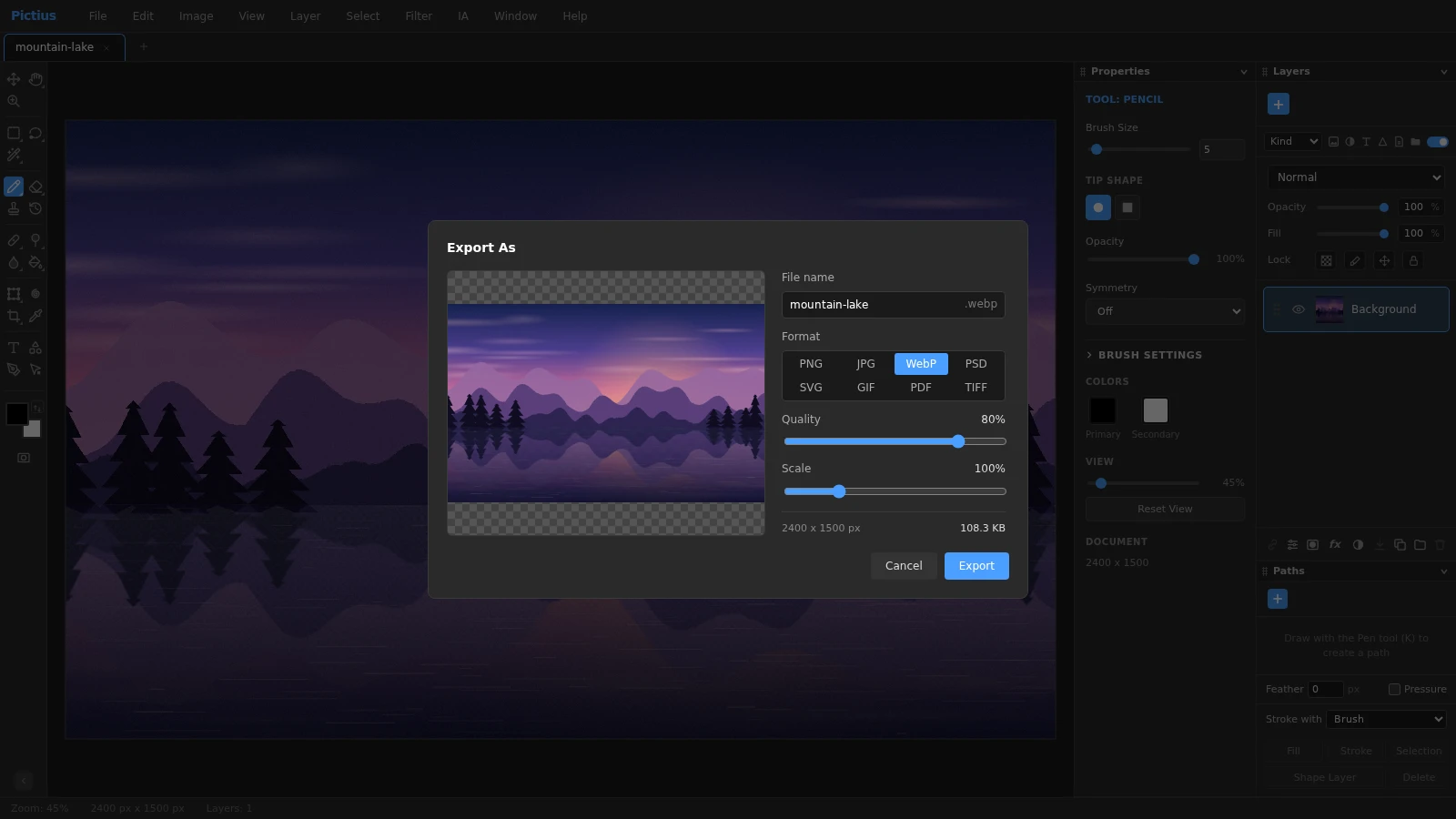
Open the image, choose File ▸ Export As… and pick the new format. The dialog previews the result and estimates the file size before you save, and the conversion happens entirely in your browser, so the image is never uploaded.
- Free
- No install, no account
- Images stay on your device
- Layers, masks and AI
Convert an image step by step
Pictius opens PNG, JPG, WebP, GIF, BMP, AVIF and SVG images, PSD files and .pictius projects.
- Open the file with File ▸ Open… (Ctrl+O). You can open several at once; each one gets its own tab.
- Choose File ▸ Export As… (Ctrl+Alt+Shift+W).
- Pick the Format: PNG, JPG, WebP, PSD, SVG, GIF, PDF or TIFF.
- Adjust the options of that format. Quality applies to JPG and WebP; Scale resizes the exported copy from 10% to 400%; Background sets the color that replaces transparency in a JPG.
- Check the preview and the estimated size, change the File name if you like, and click Export.
Which format to choose
- PNG: lossless, with transparency. Best for screenshots, logos, graphics and cutouts.
- JPG: small files for photos, but no transparency. A Quality between 80% and 90% is a good balance.
- WebP: usually smaller than JPG at similar quality, and it keeps transparency. Good for websites.
- GIF: up to 256 colors, with Dither and Transparency options. Turn on Layers as frames to make an animation: each top-level layer becomes a frame, with a Frame delay and Loop forever.
- SVG: shape layers become vector paths and text layers stay as text; photos and other pixel layers are embedded as images.
- PDF and TIFF: a single page or image for print. Set Resolution (dpi) and choose the compression: JPEG or Lossless for PDF, Deflate or None for TIFF.
- PSD: keeps layers, masks and styles, to keep working in another editor.
Quick exports and many files
File ▸ Export as PNG, File ▸ Export as JPG and File ▸ Export as WebP save straight away without a dialog, at full size. The quick JPG uses 92% quality on a white background.
To convert a whole folder, use File ▸ Automate ▸ Batch…: choose an action such as Flatten and Export PNG, select your files, turn on Override the action’s Export steps and pick the Format (PNG, JPG, WebP, PSD or Pictius project). The results are saved as a ZIP archive, as separate downloads or, in browsers that allow it, into a folder.
Good to know
Converting to JPG or lossy WebP discards some detail each time, so keep the original or a PNG if you will edit again. An animated GIF opens as its first frame, and an SVG you open becomes pixels at its own size. Exported files do not carry over camera metadata such as EXIF.
Frequently asked questions
How do I convert WebP to JPG or PNG?
Open the WebP file with File ▸ Open…, then choose File ▸ Export as JPG or File ▸ Export as PNG, or use Export As to set the quality.
Can Pictius turn a PNG into a real vector SVG?
No, it does not trace pixels into paths. An SVG export keeps shapes and text as vectors, but a photo or a pixel layer is embedded as an image inside the SVG.
Can I save images as AVIF?
Pictius opens AVIF files but does not export them. For small web images, use WebP or JPG.
Does converting to JPG reduce quality?
Yes, a little, because JPG is lossy. At 85% to 92% the difference is hard to see, while lower values make smaller files with visible artifacts.
How do I make a PDF from an image?
Choose File ▸ Export As…, pick PDF, set the Resolution (dpi) for the printed size and the compression, and click Export. The PDF has one page with the image.
Image editing guides
- Remove the background from an imageRemove the background from a photo in your browser: select the subject with AI, refine the edges with a layer mask and export a transparent PNG. No uploads.
- Remove objects from a photoErase unwanted objects, people or text from a photo: select them and use Content-Aware Fill, AI Fill, Spot Healing or Patch. Everything runs in your browser.
- Cut out hair and objects preciselyCut out people, hair, pets and products: start with Quick Selection or Select Subject, refine the edge in Select and Mask and output a layer mask or a new layer.
- Blur the background of a photoBlur the background of a photo to make the subject stand out: use Portrait Mode, or select the subject and apply Gaussian Blur to the rest. Free, in your browser.
- Resize an imageResize an image to exact pixels or a percentage with Image Size, choose the resampling method, and add or trim space around it with Resize Canvas. Free and private.
- Crop and straighten a photoCrop a photo to a ratio such as 1:1, 4:5 or 16:9, straighten a tilted horizon, fix perspective with Perspective Crop and trim empty borders. Free, in your browser.
- Upscale an imageEnlarge a small image with Super Resolution 2x, which doubles its size with smooth interpolation and sharpening, or pick an exact size and method in Image Size.
- Images at the right size for social mediaMake images at the right size for Instagram, Facebook, YouTube and more: crop to a preset ratio or use Export for Social Media to resize and save in one step.
- Open and edit PSD files onlineOpen PSD files in your browser with their layers, groups, masks, adjustment layers and effects, see what is kept or approximated, and export PSD, PNG or JPG.
- Add text to an imageAdd text to a photo with editable text layers: set font, size, color and spacing in the Character and Paragraph panels, then add a shadow or stroke with Layer Style.
- Add a watermark to your photosAdd a text or logo watermark to a photo, set its opacity and blend mode, then record it as an Action and apply it to many images at once with Batch.
- Adjust color and exposureFix dark, flat or off-color photos with Levels, Curves, Hue/Saturation and Shadows/Highlights, and keep every edit reversible with adjustment layers.
- Remove blemishes and red eyeRetouch portraits in your browser: remove spots and blemishes with Spot Healing and Healing, clone away distractions with Clone Stamp and fix red eye with one click.
- Layers and masks explainedLearn layers in Pictius: groups, blend modes, layer masks and clipping masks, adjustment layers, and .pictius project files that keep every layer editable.
- Batch edit images with ActionsRecord your edits once as an Action and play it on many images with Batch: resize, adjust, watermark and export them all in one go, right in your browser.